Choose Lisbon if it’s your first time in Europe, you want iconic sightseeing, or you have more than four days. Choose Porto if you’ve done European capitals before, you want something grittier and more local, or you’re going for a weekend. The train between them takes 2 hours 50 minutes — if time allows, visit both.
What Is the Main Difference Between Lisbon and Porto?
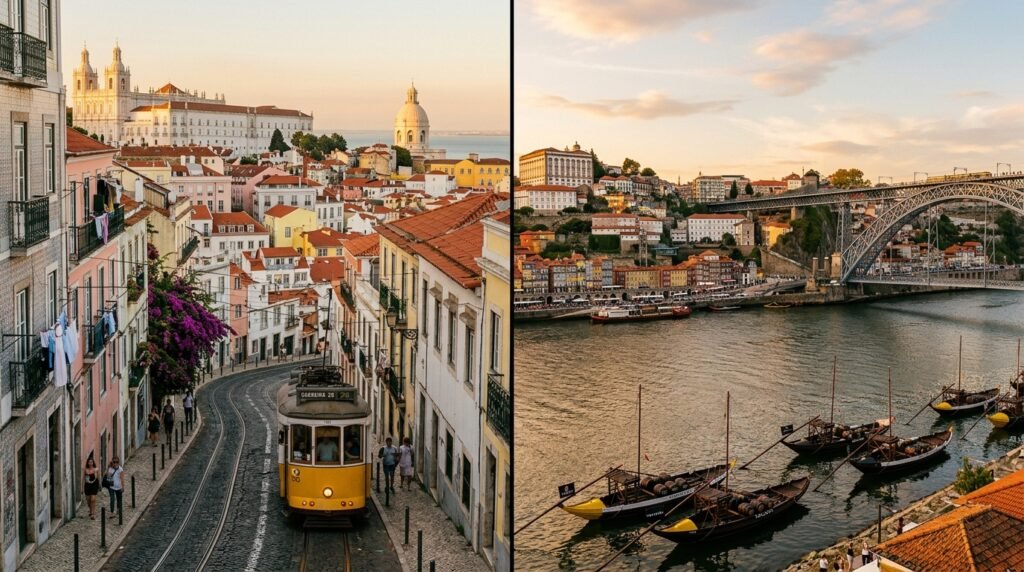
The honest answer is one sentence: Lisbon impresses you, Porto surprises you.
Lisbon stands out for its fast pace, historic charm, and global recognition — it recently won the title of Best City Break Destination at the Star Awards and topped VisaGuide.World’s list of top European capitals. It is a city that delivers on its reputation immediately: grand monuments, clifftop viewpoints, yellow trams winding through terracotta hillsides, and a river that catches the light differently every hour of the day.
Porto is different. In Porto, it is more about atmosphere. You wander through the streets, stumble across a hidden park or a beautiful tiled facade you were not expecting. The city feels less made for tourists and therefore maybe less spectacular, but often more surprising.
Porto has a more intimate, laid-back feel. It recently earned 10th place in Time Out’s Best Cities in the World list, and Condé Nast Traveller’s Readers’ Choice Awards also ranked Porto among the top cities globally.
There is also a famous Portuguese saying that captures it well: “Porto works, Braga prays, Coimbra studies, and Lisbon gets the money.” Porto’s identity as a working city — tougher, less polished, more authentically itself — is not just a tourist trope. You feel it in the streets.
Quick Comparison — Lisbon vs Porto at a Glance
| Category | Lisbon | Porto |
|---|---|---|
| Size | Larger, more spread out | Smaller, more walkable |
| Vibe | Cosmopolitan, bold, energetic | Gritty, atmospheric, local |
| Sightseeing | More monuments and museums | More about streets and atmosphere |
| Food | More variety, higher polish | More distinctive, more local |
| Budget | 10–20% more expensive | Better value overall |
| Nightlife | Excellent — one of Europe’s best | Good but smaller scale |
| Day trips | Sintra, Cascais, Évora | Douro Valley, Guimarães, Braga |
| Best for | First-timers, long trips | Experienced travellers, weekends |
| Minimum stay | 3–4 days | 2–3 days |
Lisbon vs Porto for First-Time Visitors
If you’ve never been to Europe, Lisbon is probably the right choice. It’s a great entry city to broader western Europe. However, if this is your second, third, or fourth trip to Europe, consider skipping Lisbon and heading directly to Porto.
The logic is straightforward. Lisbon, with its 6.4 million international tourists per year, has been optimised for visitors in the way that most European capital cities have. The sights are well-signed, the transport is easy to navigate, English is ubiquitous, and the restaurants catering to tourists are everywhere. None of this is a criticism — it makes for a smooth first European experience.
Porto hasn’t been optimised in the same way. The hills are steeper, some of the best restaurants have no English menu, and getting lost between the Ribeira and the upper city is part of the experience rather than a problem to be solved. For travellers who have done the major European cities and want something that feels more alive and less rehearsed, Porto delivers something Lisbon cannot.
💡 Ana Costa says: “When friends from abroad ask me where to go first, I always ask one question: have you spent time in a major European capital before? If not, Lisbon. If yes, Porto — and then come back for Lisbon on the next trip. Nobody ever regrets Porto.”
Lisbon vs Porto for Sightseeing
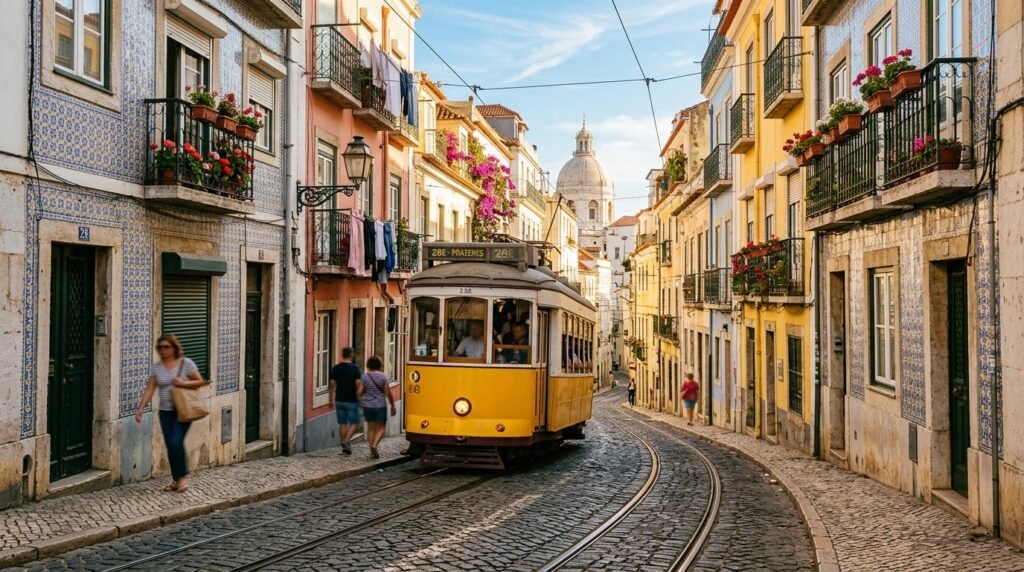
When it comes to sightseeing in the classic sense — monuments, museums, must-see places and diversity — Lisbon is the clear winner.
Lisbon’s sightseeing list is long and genuinely impressive. The Jerónimos Monastery in Belém is one of the finest examples of Manueline Gothic architecture in the world. The Belém Tower, built in the 16th century to guard the entrance to the Tagus, is a UNESCO World Heritage Site. São Jorge Castle overlooks the city from a hilltop occupied since the 1st century BC. The Alfama neighbourhood is one of Europe’s most atmospheric old towns. The National Tile Museum (Museu Nacional do Azulejo) houses the finest collection of Portuguese decorative tiles anywhere on earth.
Porto’s sightseeing list is shorter but not without substance. São Bento Station’s 20,000 hand-painted azulejo tiles are extraordinary. Livraria Lello, opened in 1906 and classified as a Portuguese National Monument in 2026, is one of the most beautiful bookshops in the world. The Dom Luís I Bridge and the Palácio da Bolsa’s Arabian Room are both genuinely worth seeing.
But Porto’s real attraction is the city itself — the texture of the streets, the tiled facades, the views from the hilltops, the atmosphere of the port wine lodges across the river. It is a city experienced more than visited.
Winner for sightseeing: Lisbon — more monuments, more museums, more landmark experiences per day.
Lisbon vs Porto for Food and Drink
Porto wins on food because it is more distinctive and the experience feels more local. Porto is also where port wine actually lives, and a visit to one of the wine cellars in Gaia with a tasting is a legitimate half-day activity, not a tourist trap.
Porto’s food identity is clear and specific. The francesinha — a meat-stuffed sandwich smothered in melted cheese and a spiced tomato-and-beer sauce — is a dish with no equivalent anywhere else in Portugal. The bacalhau preparations here are outstanding. The local Douro wines available in the port lodges and wine bars of Vila Nova de Gaia are a world away from the bottled wine served in tourist restaurants elsewhere.
Lisbon’s food scene is broader and more internationally polished. As of 2026, Lisbon and its surroundings have 46 Michelin-starred restaurants — more per square kilometre than most European capitals at the same price level. The restaurant variety is genuinely exceptional: Japanese-Portuguese fusion in Príncipe Real, natural wine bars in Chiado, seafood grills in Belém, and some of the finest pastéis de nata in existence at Pastéis de Belém, which has been baking them since 1837.
Both cities are excellent for food. The difference is that Porto’s specialities feel like discoveries; Lisbon’s feel like destinations.
Winner on distinctiveness: Porto. Winner on variety: Lisbon.

Lisbon vs Porto for Budget
Porto usually offers better value than Lisbon. Accommodation is about 20–30% lower in Porto than comparable options in Lisbon. Dining expenses, attraction entry fees, and public transport are also cheaper.
Portugal is still one of the better-value destinations in Western Europe, but both cities have gotten noticeably more expensive over the past decade. Porto consistently runs 10–15% cheaper overall — a much smaller gap than five or ten years ago.
In practical terms for 2026: a mid-range hotel in a good location in Lisbon typically costs €120–180 per night; the equivalent in Porto runs €90–130. A sit-down lunch at a local restaurant costs €12–15 in Porto versus €15–20 in central Lisbon. Port wine tastings in Gaia start from €15 — good value considering you’re tasting in the original cellars where the wine has aged for decades.
Winner on budget: Porto — meaningfully cheaper across accommodation, food, and daily expenses.
Lisbon vs Porto for Couples
Both cities offer genuinely romantic experiences, but they deliver romance differently.
Lisbon is romantic in a grand way: rooftop restaurants with Tagus River views, sunset at the Miradouro da Graça, fado in a candlelit Alfama tavern, long dinners in Príncipe Real. The city’s scale and drama create a natural backdrop for significant moments.
Porto is romantic in a quieter, more intimate way: a slow afternoon in a port wine cellar garden, discovering a miradouro that isn’t on any map, dinner at a ten-table restaurant in Bonfim where nobody is rushing you. Porto is rougher around the edges than Lisbon — crumbling colourful tiled houses frame the narrow cobblestone streets — and that roughness is part of what makes it feel genuine rather than staged.
For a honeymoon or anniversary, Lisbon offers more obvious romance infrastructure — better-positioned hotels, rooftop bars, and the kind of views that photograph beautifully. For couples who find that kind of polish slightly performative, Porto’s intimacy is the more rewarding choice.
For full romantic dining options in Lisbon, read: Best Restaurants in Lisbon for Couples →
Lisbon vs Porto for Day Trips
Lisbon has the stronger day trip lineup for most travellers.
From Lisbon: Sintra (40 minutes by train, UNESCO palaces and forested hills), Cascais (40 minutes by train, Atlantic coastline and fishing village character), Setúbal and the Arrábida Natural Park (45 minutes by car, dramatic limestone cliffs and crystal-clear water), and Évora (90 minutes by train, Roman temple and medieval walled city).
From Porto: The Douro Valley (90 minutes by car, UNESCO vineyard landscapes and port wine quintas), Guimarães (45 minutes by train, Portugal’s medieval birthplace city), Braga (30 minutes by train, extraordinary baroque architecture), and Viana do Castelo (75 minutes by train, beautiful northern coastal town).
The Douro Valley day trip from Porto is genuinely world-class — one of the most beautiful landscape experiences in Portugal — but Lisbon’s day trip variety is broader and more varied across different interests.
Winner for day trips: Lisbon — more options, more variety, stronger overall lineup.

Lisbon vs Porto: How Long Do You Need?
After a week in Lisbon, you’ll still feel like you’ve barely scratched the surface. On the other hand, a week in Porto would definitely get a bit repetitive.
This is one of the most honest and useful distinctions between the two cities. Lisbon’s size, variety, and sheer number of neighbourhoods, museums, day trips, and restaurants means it rewards extended stays. Three days gives you the highlights; four to five days lets you breathe; a full week still leaves things unexplored.
Porto is best experienced intensely and concisely. Two solid days covers the main sights. A third day for a Douro Valley excursion makes it exceptional. Beyond that, the city starts to feel familiar rather than revealing.
Best length of stay: Lisbon needs 3–5 days minimum. Porto is best at 2–3 days.
Can You Visit Both Lisbon and Porto?
Yes — and you should, if time allows. Despite the short three-hour train journey between them, tourists often do not get the chance to visit both Lisbon and Porto on a short break. This is one of the most common regrets of visitors to Portugal.
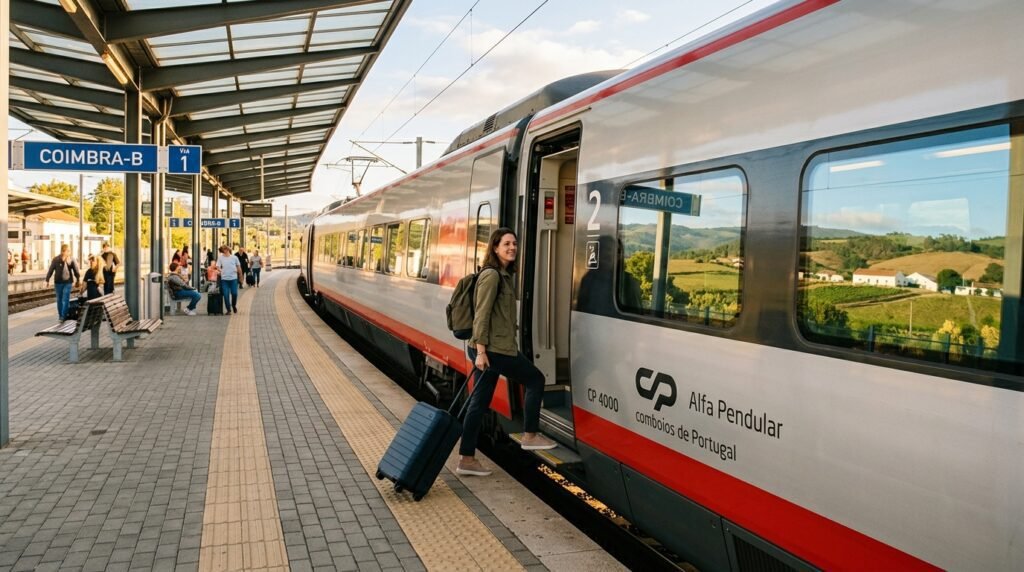
The Alfa Pendular express train connects Lisbon and Porto in 2 hours 50 minutes and costs €25–30 booked in advance at cp.pt. The journey itself is pleasant — comfortable seats, a café car, and views of the Portuguese countryside rolling past.
The ideal arrangement: three nights in Lisbon (with a Sintra day trip), then two nights in Porto (with a Douro Valley excursion), then either return to Lisbon for your flight or continue south to the Algarve. This is the backbone of our [7-Day Portugal Itinerary →] and works perfectly as a first-time Portugal route.
💡 Ana Costa says: “I lived in Portugal for eight years and I still couldn’t tell you which city I prefer. Lisbon has a grandeur Porto will never have. Porto has a soul Lisbon is still searching for. The only wrong answer is choosing one and skipping the other entirely.”
The Verdict: Lisbon or Porto?
Choose Lisbon if you:
- Are visiting Europe for the first time
- Want iconic sightseeing and world-class museums
- Are travelling with family or have mixed interests in your group
- Have four or more days available
- Want the best variety of restaurants and nightlife
- Are flying direct from the US — Lisbon has far more transatlantic connections
Choose Porto if you:
- Have been to European capitals before and want something different
- Are going for a weekend or 2–3 days specifically
- Value atmosphere over attractions
- Care deeply about food distinctiveness and local wine culture
- Are travelling as a couple and want something more intimate
- Want to base yourself somewhere more affordable
Visit both if you:
- Have five days or more
- Are on a first trip to Portugal and want the full picture
- Want to understand why the Portuguese themselves argue about this
Frequently Asked Questions — Lisbon vs Porto
Is Lisbon or Porto better for a first visit to Portugal? Lisbon is the better choice for a first visit, particularly for first-time visitors to Europe. It offers more iconic sightseeing, better international transport connections, and a broader range of experiences. Porto is the better choice for experienced European travellers wanting something grittier and more local.
Is Porto cheaper than Lisbon? Yes — Porto is consistently 10–20% cheaper than Lisbon across accommodation, dining, and daily expenses. Hotel prices in Porto run approximately 20–30% lower than comparable options in Lisbon. Both cities are good value by Western European standards.
How far is Porto from Lisbon? Porto is approximately 315 kilometres north of Lisbon. The Alfa Pendular express train covers the distance in 2 hours 50 minutes and costs €25–30 booked in advance. Budget airlines also operate the route in under an hour.
Which city has better food — Lisbon or Porto? Both are excellent but in different ways. Lisbon has more variety, more Michelin-starred restaurants, and a broader international food scene. Porto has more distinctive local dishes — particularly the francesinha and port wine tastings in Vila Nova de Gaia — and a more local feel in its restaurants.
Is Porto or Lisbon better for a weekend trip? Porto is the better choice for a weekend trip of 2–3 days. It is more compact, more walkable, and its highlights are concentrated enough to be explored thoroughly in a short visit. Lisbon benefits from longer stays.
Can you see both Lisbon and Porto in one week? Yes — three nights in Lisbon with a Sintra day trip, followed by two nights in Porto, is a well-paced one-week itinerary that covers both cities without feeling rushed. Read our full [7-Day Portugal Itinerary →] for the exact day-by-day plan.
Let Our AI Plan Your Portugal Trip
Tell us the occasion, how many days you have, and what matters most — and our AI travel planner will recommend whether Lisbon, Porto, or both belong in your itinerary.
Explore each city in depth:
- Lisbon Travel Guide 2026 →
- Porto Travel Guide 2026 →
- Sintra Day Trip from Lisbon →
- 7 Days in Portugal — Complete Itinerary →
- Is Portugal Safe in 2026? →
Last updated: June 2026. City rankings and awards sourced from Time Out Best Cities 2026, Condé Nast Traveller Readers’ Choice Awards, and VisaGuide.World European Capital Rankings. Train prices from CP-Comboios de Portugal (cp.pt).