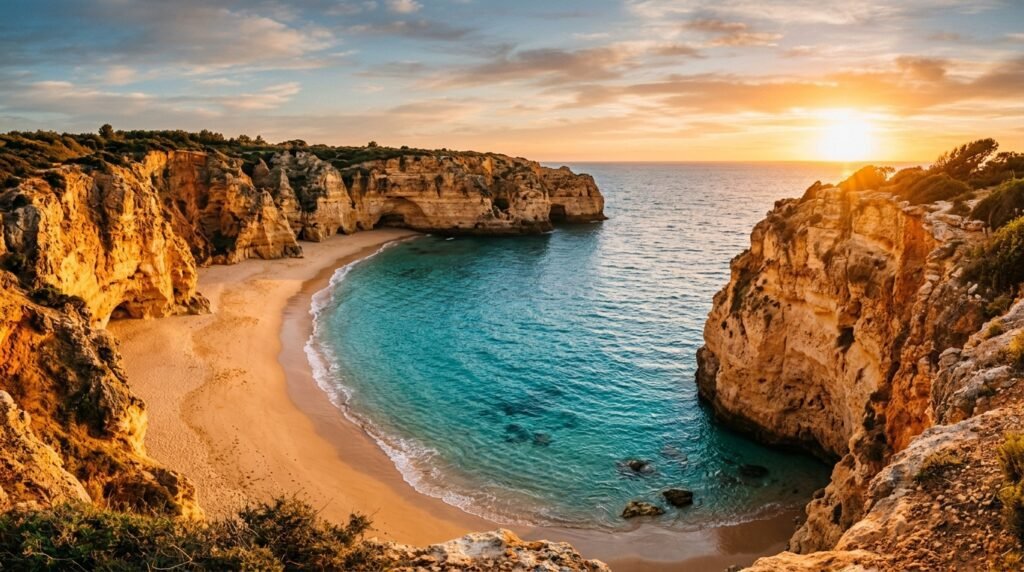
The honest answer: in July and August, no Algarve beach is truly empty. But the difference between a beach with 2,000 people and one with 30 comes down to three things — where you go, when you arrive, and how far you’re willing to walk. Get those three things right and you’ll find the Algarve that the photographs promised: golden limestone cliffs, turquoise water, and enough space to hear the sea.
This guide gives you the specific beaches, the exact access routes, the timing that actually works, and the 2026 rule changes that affect the most famous spots — so you can plan a coastline trip without spending the best days of it queueing in a car park.
Why Algarve Beaches Get So Crowded — and When It Actually Matters
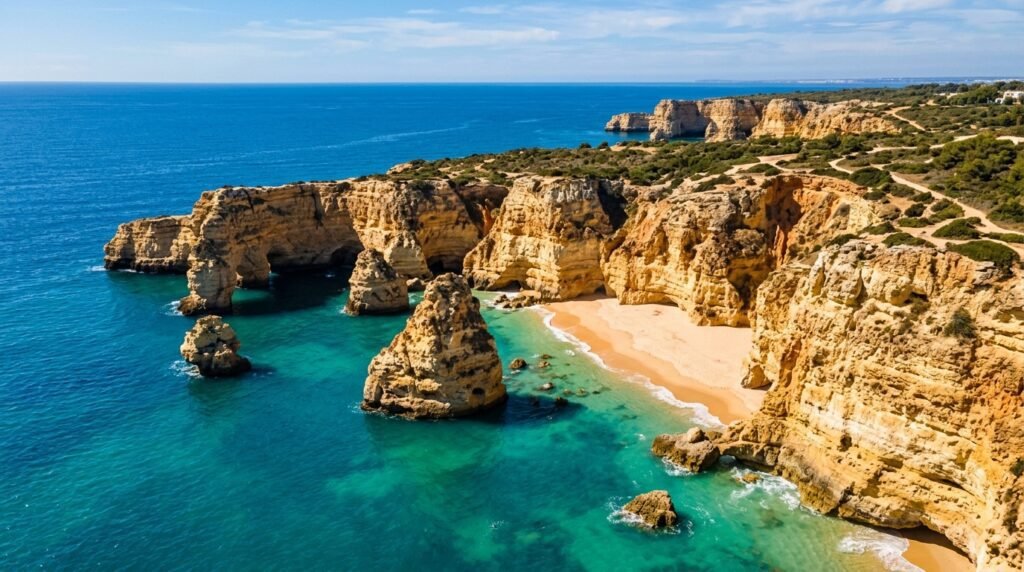
The Algarve has almost 200 kilometres of coastline and more than 80 Blue Flag beaches. The problem is not the number of beaches — it’s that most tourists visit the same ten, arrive at the same time, and then wonder why it’s packed.
The busiest months are July and August, particularly the two middle weeks of August when Portuguese school holidays overlap with European peak travel. The most overcrowded beaches in this period are consistently Praia da Rocha, Meia Praia, Albufeira’s main beach, and Falésia.
The genuinely uncrowded beaches require either a longer drive, a short walk along a cliff path, or an early morning arrival. Most reward the small extra effort dramatically. Here’s where to go.
Western Algarve: The Least Discovered Coastline
The western Algarve — from Lagos toward Sagres and the Costa Vicentina — sees significantly fewer tourists than the central strip between Albufeira and Portimão. The landscapes here are wilder, the cliffs are higher, and the Atlantic is more powerful. The swimming is generally calmer in the sheltered coves; the open beaches face the full force of the ocean and are better for watching waves than swimming.
Praia da Salema — A Working Fishing Village Beach
Between Sagres and Lagos, Praia da Salema is backed by a genuine working fishing village where boats still go out in the morning and return in the afternoon. The beach is long enough to absorb its visitors comfortably, and those visitors are overwhelmingly Portuguese families rather than package tourists.
There are good restaurants immediately behind the beach and easy parking nearby. The water is calm and the atmosphere is unhurried. It never feels empty in summer, but it never feels overwhelmed either.
How to get there: No direct train — best reached by car or bus from Lagos. About 20 minutes drive west of Lagos town centre.
Best time: Morning, any day of the week. This beach draws locals more than tourists, so weekdays are noticeably calmer.
Praia do Barranco — Near-Empty Even in August
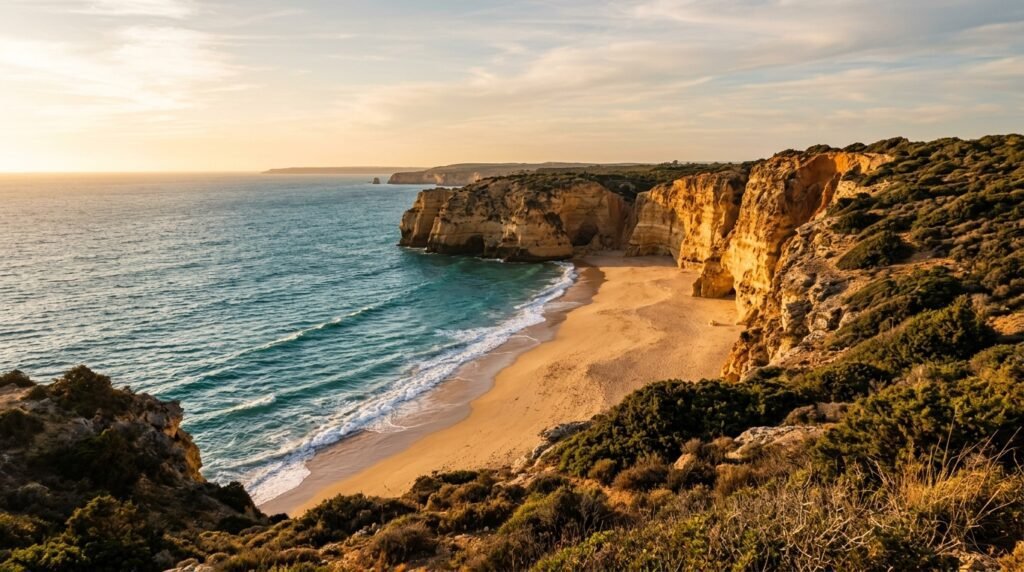
A few kilometres further west toward Sagres, Praia do Barranco is accessed via a dirt track that keeps most tourist traffic away. The surrounding landscape is green valleys, high cliffs, and usually-calm water — essentially nothing else. It has long been popular with campers and naturists, and remains largely undiscovered by everyone else.
No facilities whatsoever. Bring water, food, and everything you need for the day.
How to get there: Dirt track access from the road near Sagres — a standard car can manage it slowly. Do not attempt in a small hire car after rain.
Best time: Any time. The access road alone filters most of the crowds.
Central Algarve: Going Beyond the Famous Names
The central Algarve — from Carvoeiro to Albufeira — has the most famous beaches in Portugal. It also has several that most tourists never reach because they’re separated from the famous ones by a short cliff walk that most people don’t attempt.
Praia de Albandeira — 80 Metres of Sheltered Sand
Tucked in the Porches region between Portimão and Lagoa, Praia de Albandeira is a small cove of around 80 metres, enclosed by limestone cliffs with natural rock formations in the water. It has basic facilities — a café, sunbeds, showers — and is lifeguard-monitored in summer, making it suitable for families.
The key is timing: arrive before 10am and you’ll find the beach largely empty. By noon it fills. By 3pm, as day-trippers begin leaving, it empties again.
How to get there: By car — free parking nearby. About 10 minutes from Carvoeiro, 15 from Portimão.
Praia do Barranquinho — The Unmarked Secret Cove
This is genuinely one of the Algarve’s best-kept secrets. Praia do Barranquinho sits just along the coast from Praia de Albandeira, reached via an unmarked path from the Albandeira car park. Walk with the sea in front of you, take the path heading right along the cliff, and follow it for 5–10 minutes. You cannot miss it — a huge rock standing in the ocean opposite a small sandy cove signals your arrival.
The water is clear and calm. A large islet sits directly in front of the beach, creating a sheltered swimming area. The setting is extraordinary and the access route keeps the crowds minimal.
How to get there: Park at Praia de Albandeira’s car park (free) and walk the coastal path east for 5–10 minutes.
Best time: Any time before noon. This beach does appear on social media now, so mornings are always quieter than afternoons.
Praia do Carvalho — Hidden Down a Tunnel
One of the most atmospheric beaches in the Algarve, Praia do Carvalho is accessed through a short tunnel carved directly through the cliff. The beach on the other side is small, sheltered, and the kind of place that earns its reputation.
It sits on the Seven Hanging Valleys Trail (Percurso dos Sete Vales Suspensos) between Benagil and Praia da Marinha, so it’s reachable on foot from either direction along the cliff path. The tunnel access keeps casual visitors away — most people at Praia do Carvalho walked there.
How to get there: On foot from Benagil Beach (west) or Praia da Marinha (east) via the cliff trail. By car to the top of the cliff with a short steep walk down.
The Seven Hanging Valleys Trail — The Best Way to Find Empty Algarve Beaches
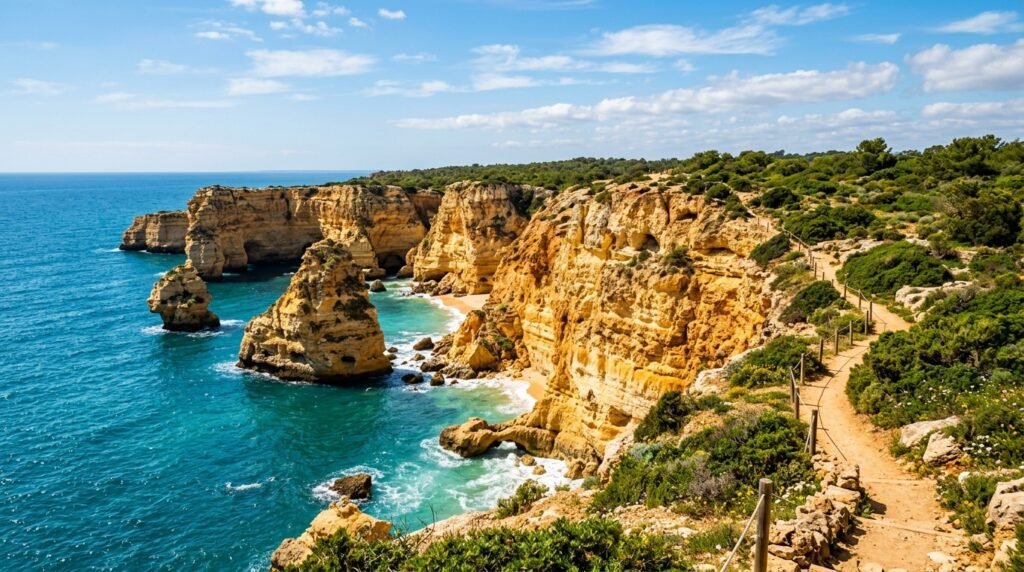
The Percurso dos Sete Vales Suspensos is a 7-kilometre cliff-top trail connecting Praia da Marinha in the east to Praia de Vale de Centeanes in the west, passing directly above Benagil Cave and through some of the most spectacular coastal scenery in Europe. Many rate it the finest coastal walk in Portugal.
The beaches you reach via the trail — Praia do Carvalho, Praia da Corredoura, Praia de Benagil — are all accessible by the same crowds that drive to the car parks above them, but the ones between, reached only by continuing along the path, are significantly quieter. The further you walk from a car park, the fewer people you share the beach with. This is the closest thing to a guaranteed formula for finding space in central Algarve.
Trail details: 7km one way (14km return), approximately 3 hours at a comfortable pace. Flat and accessible for most fitness levels, with some sections close to cliff edges. Bring water, sun protection, and a swimsuit — there are beaches to swim from along the route.
Start points: Praia da Marinha car park (east end) or Praia de Vale de Centeanes (west end). Both have free parking.
Benagil Cave in 2026 — What the New Rules Mean for Your Visit
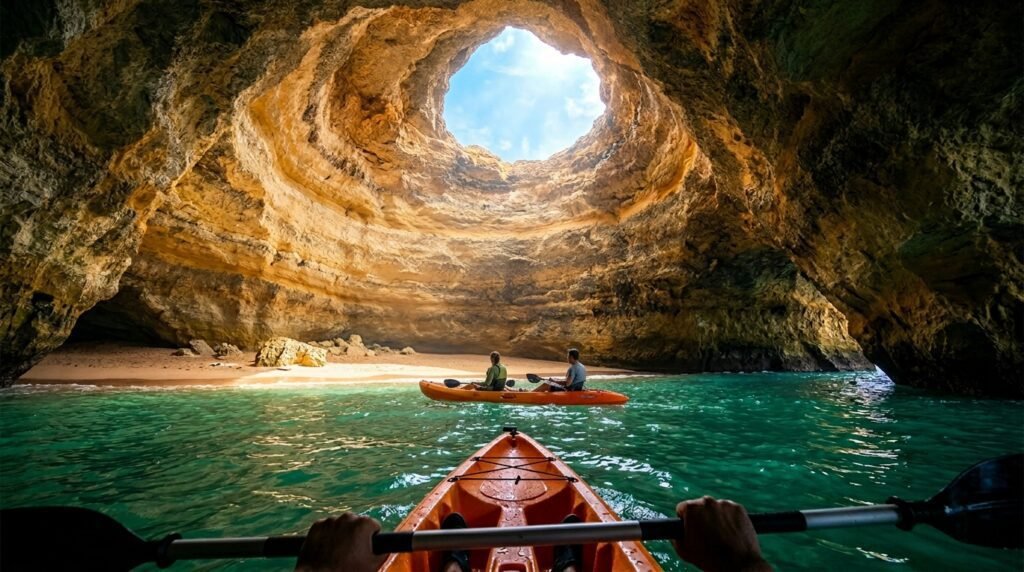
No guide to the Algarve coast is complete without addressing Benagil Cave — the sea cave with a natural skylight illuminating a hidden sandy beach inside, arguably the single most photographed place in Portugal.
The important update: Rules introduced in 2023 and fully enforced since 2024 mean you can no longer swim into the cave or access it independently. The rules are strict:
- Entry to the cave is only permitted via a licensed guided tour on a kayak, SUP, or small boat
- Swimming into the cave is banned
- Motorised boats are permitted a maximum of 2 minutes inside the cave
- Kayaks and SUPs are permitted a maximum of 8 minutes inside
- You cannot land on the sand inside the cave — you must stay on the water
This is enforced by water police.
What this means practically: You need to book a guided tour in advance. The cave is still absolutely worth seeing — the experience of floating inside with the light falling through the skylight is genuinely extraordinary. But walk-in access is gone.
Choosing the right tour:
- Kayak or SUP tours get more time inside than motorised boats and get you closer to the cave walls. Best for experiencing the cave properly.
- Small RIB speedboat tours cover more ground along the coastline and are better for those who want to see multiple beaches in one trip.
- Large catamaran tours are the most comfortable option but get the least time inside the cave.
Book at least 2–3 days ahead in July and August. Morning departures (before 10am) have the calmest sea conditions and best light inside the cave.
👉 [Browse Benagil Cave kayak and boat tours on GetYourGuide →]
Praia da Marinha — Europe’s Most Beautiful Beach, On Your Terms
Praia da Marinha is frequently cited among the most beautiful beaches in Europe — and the natural rock arches, limestone stacks, and extraordinary clarity of the water fully justify the description. It is also, in mid-August, genuinely crowded.
The solution is simple and works consistently: arrive before 9am. The small car park fills by 10am, after which police close the access road and no further vehicles are admitted. Arrive at 8:30am in summer and you’ll find one of Europe’s great beaches almost to yourself, in the best morning light.
Alternatively, visit in May, June, September, or October. In shoulder season, Praia da Marinha is near-empty on weekday mornings — one of the genuine rewards of avoiding peak travel dates.
How to get there: By car — free parking at the cliff top, 5 minutes walk to the beach. By taxi or Uber from Carvoeiro (10 minutes) or Portimão (20 minutes). There is no direct bus.
Praia das Fontainhas — Worth the Difficult Descent
In the western Algarve north of Sagres, Praia das Fontainhas requires a challenging hike down to the beach that keeps it genuinely quiet even in high season. Those who make it describe clear waters perfect for swimming between coves, orange cliffs catching the evening light, and a coastal atmosphere that feels completely removed from the tourist Algarve.
The sunset here — orange cliffs, golden light, empty beach — is one of the most photographed in the western Algarve. Arrive in the late afternoon and stay for it.
How to get there: By car, with a moderately strenuous hike down and back up. The path is marked but demanding. Not suitable for those with limited mobility. Bring good footwear — not flip flops.
Practical Tips for Algarve Beaches in 2026
Arrive before 9am or after 3pm. This single rule makes more difference than any other. The window between 10am and 2pm is when Algarve beaches are at their most crowded. Both ends of the day are dramatically calmer.
Weekdays beat weekends everywhere. Tuesday through Thursday consistently have lower car park pressure and beach density than Saturday and Sunday.
Rent a car. The hidden beaches of the western Algarve and many of the central coves are inaccessible without one. A rental also lets you leave early for the morning beaches and move between spots efficiently.
Check the sea conditions before water activities. The Atlantic is not the Mediterranean. Strong currents and unexpected wave sets occur even on apparently calm days, particularly on the more exposed western beaches. Always swim at supervised beaches when in doubt and check the flag status before entering the water.
Never leave valuables in a parked car. Rental car break-ins at Algarve viewpoints and beach car parks are well documented. Take everything with you or use a hotel safe.
Book Benagil cave tours before you arrive. Don’t leave this until you’re standing on the cliff. July and August slots disappear days in advance.
FAQ — Algarve Beaches Without Crowds
What is the least crowded beach in the Algarve? Praia do Barranco near Sagres and Praia da Murração in the Costa Vicentina Natural Park are consistently the quietest, thanks to dirt-track access that filters out most tourist traffic. In the central Algarve, Praia do Barranquinho — reached by a 10-minute unmarked coastal walk — offers surprising seclusion very close to the popular beaches.
When is the best time to visit Algarve beaches without crowds? May, June, September, and October offer the best combination of warm weather, calm sea, and manageable crowds. In July and August, arrive before 9am or after 3pm to find space even on the popular beaches.
Can you still swim into Benagil Cave? No. Since September 2023, swimming into Benagil Cave has been banned. Access is only permitted on a licensed guided kayak, SUP, or small boat tour. The cave is still absolutely worth visiting — book your tour in advance, especially in summer.
Is the Seven Hanging Valleys Trail difficult? It is a 7-kilometre cliff-top trail suitable for most fitness levels. The terrain is mostly flat with some uneven sections near cliff edges. Allow 3 hours at a relaxed pace, bring water and sun protection, and wear proper walking shoes rather than sandals.
Do I need a car to explore Algarve beaches? For the hidden beaches in this guide, yes — a car is essential. Many of the quieter coves have no direct bus service and are inaccessible by public transport. Car hire in the Algarve is widely available and relatively affordable outside peak summer weeks.
What are the most overrated beaches in the Algarve? Praia da Rocha in Portimão and Albufeira’s main beach have excellent facilities and good sand, but draw enormous crowds in summer. If your priority is space and scenery over facilities, skip these and head to the beaches in this guide instead.
Find Your Perfect Algarve Spot
Tell our AI travel planner your travel dates and what you’re looking for — quiet coves, family-friendly swimming, dramatic cliff walks, boat trips — and we’ll build a personalised Algarve itinerary that actually matches your trip.
Explore more Portugal:
- [Is Portugal Safe to Visit in 2026? →]
- [Sintra Day Trip from Lisbon →]
- [Things To Do in Porto in 3 Days →]
- [Best Restaurants in Lisbon for Couples →]
Last updated: June 2026. Benagil Cave access regulations confirmed from Portuguese Maritime Authority guidelines 2024. Beach access details verified from current sources. Always check local conditions before visiting remote beaches.