The short answer: ETIAS is launching in Q4 2026 — but as of right now, you cannot apply yet. When it does launch, it will cost €20, take about 10 minutes to complete online, and be valid for three years. It is not a visa. It is a mandatory pre-travel authorisation that Americans, Canadians, Australians, and British travellers will need before entering Portugal and 29 other European countries.
What you need to know right now: there are already over 100 fake websites charging Americans up to €100 for “early access” ETIAS applications that don’t exist yet. Frontex — the EU Border Agency — has officially warned travellers about this scam. The only legitimate ETIAS application will be at travel-europe.europa.eu and it is not open yet.
This guide covers everything Americans need to know about ETIAS for Portugal — what it is, what it isn’t, when to apply, how to apply correctly, and how to avoid losing money to the scam sites that are already circulating.

What Is ETIAS and Why Does It Matter for Portugal?
ETIAS stands for the European Travel Information and Authorisation System. It is the EU’s new pre-travel screening requirement for citizens of countries that currently enjoy visa-free access to Europe — including the United States, United Kingdom, Canada, Australia, New Zealand, Japan, and around 55 other countries.
Americans do not need a visa for short stays in Europe, and ETIAS does not change that. What is changing is that starting in Q4 2026, Americans will need to complete a quick online authorisation before their trip.
The closest comparison most Americans will recognise is the ESTA — the Electronic System for Travel Authorization that the US requires from foreign visitors before boarding flights to America. ETIAS works the same way in reverse: online application, small fee, digital authorisation linked to your passport, valid for multiple trips.
One ETIAS authorisation covers all 30 countries for three years — you don’t need separate applications for France, Italy, Greece, or Spain. One application handles all of them.
What ETIAS covers: ETIAS covers all 29 Schengen Area countries: 25 EU members including France, Germany, Italy, Spain, Portugal, and Greece, plus Norway, Iceland, Liechtenstein, and Switzerland. Cyprus is also included, making 30 countries in total.
When Does ETIAS Launch — And Can You Apply Now?
ETIAS is coming in Q4 2026 — likely October or November. It will affect every US, UK, Canadian, Australian, and other visa-free traveller visiting France, Spain, Italy, Germany, Greece, Portugal, and 24 other European countries.
ETIAS is launching in late 2026 with a phased rollout that means most travellers won’t need it immediately, but it will become mandatory in 2027.
Can you apply right now? No. The ETIAS application portal is expected to open in Summer 2026, with the system becoming operational in Q4 2026. Any site accepting applications before then is not official.
This matters enormously — and we’ll explain exactly why in the scam warning section below.
💡 What to do right now: You cannot apply yet. What you can do is check your passport validity (it needs at least 3 months validity beyond your planned return from Europe — ideally 6 months), bookmark the official EU travel site at travel-europe.europa.eu, and watch for the official launch announcement later in 2026.

CRITICAL: The ETIAS Scam Warning Every American Must Read
This section could save you money and a serious headache.
There are already more than 60 fake websites claiming to sell the yet-to-be-introduced visa waiver. When the time does come, the only place to apply for an ETIAS will be on the official website. Any apps, websites, or social media posts suggesting there is an alternative route are impostors.
Frontex — the EU Border Agency — has identified over 100 unofficial websites claiming to process ETIAS applications. These sites charge inflated fees of €50 to €100 or more, may steal personal information, and cannot actually issue valid travel authorisations. Only the official EU portal can issue legitimate ETIAS authorisations. There is no “premium processing” or authorised third-party service. The only official ETIAS website ends in .europa.eu.
Some fraudulent sites collect payment for ETIAS applications without processing them. Travellers think they have the necessary documents for travel, but in fact the authorisation will not be there, creating problems at the border. Some websites are solely created for the purpose of stealing credit card information.
How to spot a fake ETIAS site:
- It charges more than €20 per person
- It claims to accept applications before the official Q4 2026 launch
- It offers “fast-track,” “premium,” or “expedited” processing — these do not exist
- It does not end in .europa.eu
- It appears in a Google ad rather than organic search results
The only official ETIAS website: travel-europe.europa.eu/etias
Director of the ETIAS Central Unit Division at Frontex has warned: “We are aware of several sites that claim to already accept ETIAS applications. Travellers should be very cautious about those websites, as it is not currently possible to apply for an official ETIAS travel authorisation since the system is not operational yet.”
If you have already paid a third-party site for ETIAS, your payment was not legitimate. Report it to your bank and request a chargeback immediately.
Who Needs ETIAS for Portugal in 2026?
ETIAS applies to citizens of all visa-exempt countries planning short stays in Portugal and the Schengen Area. This includes:
- United States citizens
- United Kingdom citizens
- Canadian citizens
- Australian citizens
- New Zealand citizens
- Japanese citizens
- And around 55 other nationalities
Who does NOT need ETIAS:
- EU citizens — no authorisation required
- People who already hold a Schengen visa or valid residency permit for any EU country
- Travellers under 18 — exempt from the €20 fee (still need the authorisation)
- Travellers over 70 — exempt from the €20 fee (still need the authorisation)
- Digital nomad, D7, or other long-stay visa holders — your visa already covers you
Does ETIAS cover Madeira and the Azores? Yes — both the Azores and Madeira are autonomous regions of Portugal and part of the Schengen Area. Your ETIAS covers travel to all of Portugal’s territory including these Atlantic island groups. No separate authorisation is needed.
How to Apply for ETIAS: Step by Step
When the portal opens in Q4 2026, here is exactly how the application works:
Step 1 — Go to the official portal Apply only at travel-europe.europa.eu/etias — this is the only legitimate application site, operated directly by the European Union.
Step 2 — Complete the online form The form asks for: your full name, date of birth, nationality, passport details, home address, phone number, email address, intended destination and travel dates, and a series of security and health background questions. Having all this information handy will make the process quicker and easier.
Step 3 — Answer security questions honestly These questions cover your travel and immigration history in Europe, any criminal convictions, and health-related screening questions. Answer truthfully. False information equals automatic denial plus potential future entry ban.
Step 4 — Pay the €20 fee The cost is €20 per adult, it takes 10 minutes to apply, and it lasts 3 years. Travellers under 18 and over 70 are exempt from the fee but still need to complete the application.
Step 5 — Receive your authorisation Most applications are approved within minutes. Some are referred for manual review and can take up to four days. Apply a minimum of 2–3 weeks before departure. If you are flagged for manual review and travelling soon, you could miss your trip with no refund on flights and hotels.
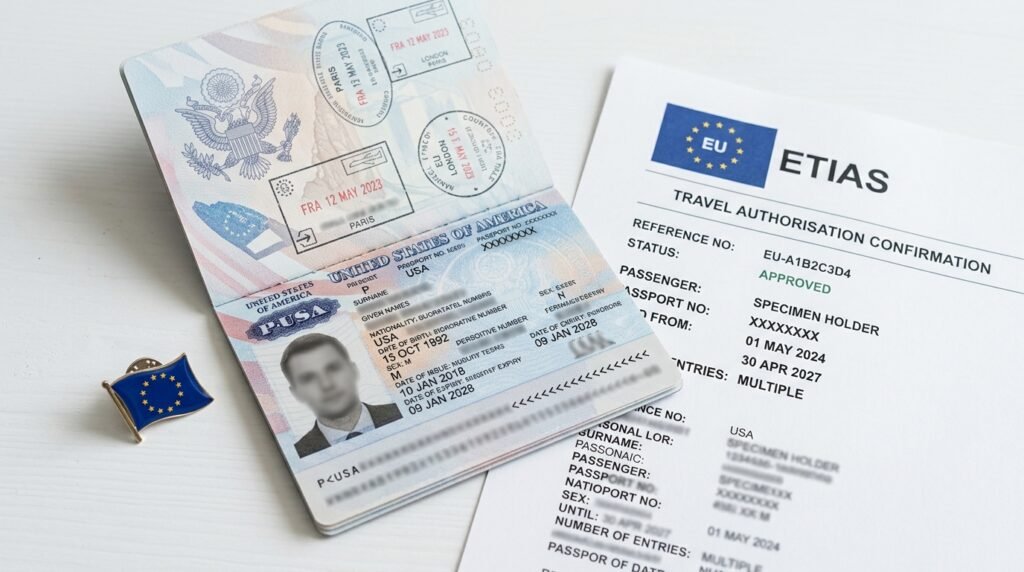
Step 6 — Travel Your ETIAS authorisation is linked digitally to your passport — you do not receive a stamp or sticker. Airlines and border officials verify it automatically when you check in and when you arrive. Print or save a confirmation copy in your email just in case.
What Documents Do You Need to Apply?
Before you sit down to apply, have these ready:
- Valid US passport — with at least 3 months validity beyond your planned return date from Europe (6 months recommended)
- Personal details — full legal name as shown on passport, date of birth, nationality
- Contact information — current home address, phone number, email address
- Travel plans — intended first destination country and expected arrival date
- Payment card — credit or debit card to pay the €20 fee
That is everything. No supporting documents, no photos, no appointment needed.
How Long Does ETIAS Last?
ETIAS does not change any travel rules. You still get 90 days in any rolling 180-day period across all 29 Schengen countries combined, just as you do now. The 90 days is shared across all Schengen countries — hopping between them does not reset your clock.
Your ETIAS authorisation itself is valid for three years from the date of approval, or until your passport expires — whichever comes first. If you renew your passport, you will need to apply for a new ETIAS linked to the new passport.
One authorisation covers unlimited trips across all 30 ETIAS countries during its validity period. You do not need to apply again for each trip.
The 90/180 Day Rule — What Americans Must Understand
This is the rule that most Americans on longer European trips get wrong, and the consequences of overstaying are serious.
As an American, you can spend 90 days in any rolling 180-day period in the Schengen Area in total — not 90 days in each country. Every day spent in France, Germany, Spain, Portugal, or any other Schengen country counts toward the same shared 90-day total.
Example: You spend 30 days in France, then 30 days in Italy, then fly to Portugal. You have 30 days of your allowance remaining — not a fresh 90 days.
With the new EES system actively tracking entries and exits digitally, overstays will be automatically flagged. Overstaying is no longer something that might go unnoticed. The consequences include being denied entry on future visits, deportation, and being banned from the Schengen Area.
If you want to spend more than 90 days in Portugal, you need a proper long-stay visa — the D7 Passive Income Visa or the D8 Digital Nomad Visa are the most common routes for Americans.
EES vs ETIAS — What’s the Difference?
These two systems are separate and frequently confused. Here’s the clear distinction:
| EES | ETIAS | |
|---|---|---|
| What it is | Digital border tracking system | Pre-travel authorisation |
| Status | Already live since April 10, 2026 | Launching Q4 2026 |
| What you do | Nothing — border officials handle it | Apply online before travel |
| Where it happens | At the border on arrival | Before you leave home |
| Cost | Free | €20 per adult |
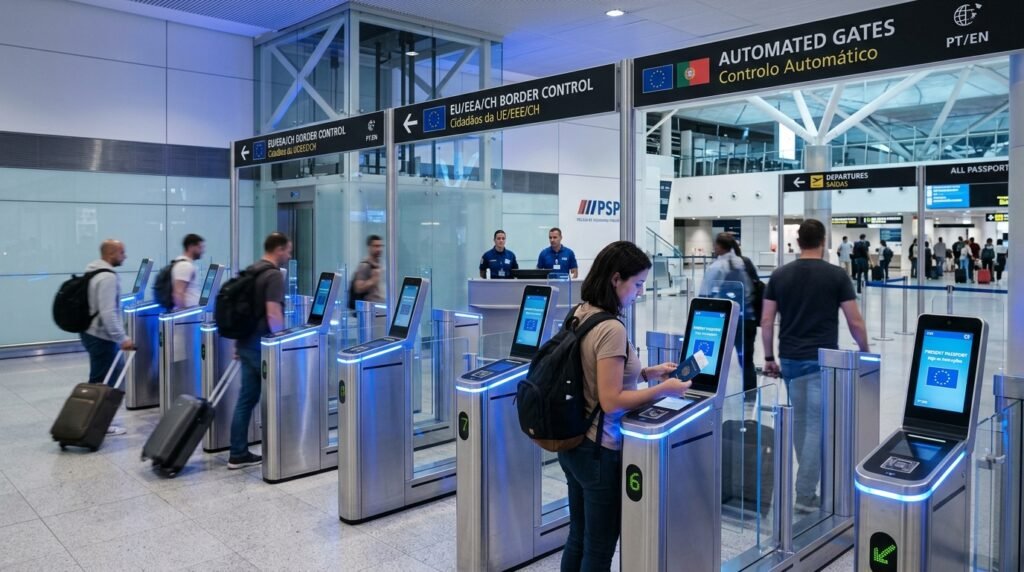
EES is now live across all 29 Schengen countries — every non-EU traveller crossing an external Schengen border is being registered biometrically. This means when you land at Lisbon airport right now, border officials are already collecting your fingerprints and a photo as part of the new digital entry system. You do not need to do anything in advance — it happens at the border automatically.
ETIAS is the separate system that requires you to apply online before you travel. It is not yet active.
Do I Need ETIAS for a Connecting Flight Through Europe?
Yes. If your connecting flight goes through a Schengen airport — such as Frankfurt, Paris, Amsterdam, or Madrid — you will need ETIAS because you are technically entering the Schengen Area, even if you don’t leave the airport.
This catches many Americans off guard. If your route to a non-Schengen destination includes a layover at a major European hub, check whether that airport is in the Schengen Area and plan accordingly.
Note: If your connection is through an airport outside the Schengen Area — such as Istanbul or Dubai — ETIAS does not apply for the connection itself.
What Happens If Your ETIAS Application Is Denied?
Denials are uncommon — estimated at less than 2% of applicants. Common reasons include outstanding alerts in EU or international security databases, previous immigration violations in Europe, serious criminal convictions, or incomplete application information. You can appeal the decision to the EU member state you plan to visit.
If your ETIAS is denied, your options are: appeal the decision, apply for a Schengen visa through the Portuguese consulate in the US instead, or address the underlying issue and reapply.
An ETIAS denial does not automatically mean you cannot travel to Portugal — it means you need to pursue the standard visa route rather than the visa-free authorisation route.
Frequently Asked Questions — ETIAS Portugal
Do Americans need ETIAS to visit Portugal in 2026? ETIAS is expected to launch in Q4 2026. Once live, all American citizens will need an ETIAS authorisation before entering Portugal. Until it launches, Americans continue entering Portugal visa-free with just a valid passport, as before.
How much does ETIAS cost for Americans? €20 per adult — approximately $21 USD. Travellers under 18 and over 70 are exempt from the fee but still need the authorisation. The fee is paid online at the time of application.
Where do I apply for ETIAS? Only at travel-europe.europa.eu/etias — the official EU portal. Any other website charging for ETIAS applications is fraudulent. Do not pay any third-party site. The official system is not yet accepting applications as of the time of publication.
How long does ETIAS last? Three years from approval, or until your passport expires — whichever comes first. It covers unlimited trips to all 30 ETIAS countries during that period.
Does one ETIAS cover all of Europe? Yes. One ETIAS authorisation covers all 30 countries: the 29 Schengen Area members plus Cyprus. You do not need separate applications for Portugal, France, Italy, or any other covered country.
Does ETIAS cover Madeira and the Azores? Yes — both are autonomous regions of Portugal within the Schengen Area. Your ETIAS covers all of Portuguese territory including the islands.
Can I apply for ETIAS right now? No. The application portal is not yet open. Any website currently accepting ETIAS applications is a scam. Apply through the official EU portal when it opens in Q4 2026.
What passport validity do I need for ETIAS? Your passport must be valid for at least 3 months beyond your planned departure date from Europe. Six months validity is recommended to avoid any issues at check-in or border control.
Plan Your Portugal Trip Around ETIAS
Once your ETIAS authorisation is confirmed, the hard part is done — now comes the enjoyable planning. Tell our AI travel planner your dates, travel style, and occasion, and we’ll build a personalised Portugal itinerary in minutes.
👉 [Start planning my Portugal trip →]
Explore more essential Portugal guides:
- [Portugal Travel Tips for Americans — Complete 2026 Guide →]
- [Is Portugal Safe to Visit in 2026? →]
- [Sintra Day Trip from Lisbon →]
- [Things To Do in Porto in 3 Days →]
Last updated: June 2026. ETIAS launch timeline and specifications sourced from the European Commission, Frontex, and official EU Migration and Home Affairs publications. The ETIAS application portal had not yet opened at time of publication. Verify current status at travel-europe.europa.eu before applying.