Portugal is one of the best decisions an American can make for a European trip in 2026. The flight from New York is under seven hours. English is widely spoken in every city. The food is excellent, the wine is cheap, the people are genuinely warm, and the whole country costs roughly half what France or Italy would for the same quality of experience.
But Portugal is not America with better weather. There are a handful of things it doesn’t tell you in advance — a cover charge that appears on your restaurant bill, a very different relationship with meal times, driving habits that will make your palms sweat, and a new pre-travel requirement that every American needs to know about before booking flights. This guide covers all of it, so nothing catches you off guard.
What Americans Need to Know Before They Book
ETIAS — The New Pre-Travel Requirement for 2026
American travellers heading to Portugal in 2026 will soon need to complete an important new requirement before departure: the ETIAS travel authorisation. Whether flying into Lisbon, connecting through Porto, or heading straight to the islands, this rule applies to every journey.
Here’s what it actually means for you:
ETIAS is an online pre-travel authorization, not a visa. It costs approximately €7, is valid for three years, and approval typically takes minutes to a few days. You apply online, answer a series of background questions, pay the fee, and receive your authorisation before departure. It is similar to the ESTA system Americans already use for domestic travel to countries like Australia and New Zealand.
Americans can visit Portugal visa-free for 90 days within any 180-day period. Portugal is part of the Schengen Area, so days spent in Portugal count toward your total Schengen allowance. This matters if your Portugal trip is part of a wider European itinerary — every day spent in France, Italy, Spain, or any other Schengen country counts toward the same 90-day total.
What to do: Apply for ETIAS online before your travel date once the system is fully operational. Do not apply through third-party sites that charge inflated fees — the official application is through the EU’s own portal and costs €7 total.
💡 Important note for 2026 travellers: As of the time of publication, ETIAS is expected to launch in late Q4 2026. Check the official ETIAS website before travel to confirm whether the system is active for your travel dates.
Travel Insurance — Get It, Every Time
Americans visiting Portugal are not covered by Europe’s national health systems. If you get sick, injured, or need emergency treatment, you will be billed at private rates. A single emergency room visit can cost several thousand euros without insurance.
Comprehensive travel insurance covering medical emergencies, trip cancellation, and baggage loss is not optional — it’s essential. Budget approximately $50–$150 for a two-week policy depending on your age and level of cover. It costs almost nothing relative to the financial risk of travelling without it.
Plug Adapters and Voltage
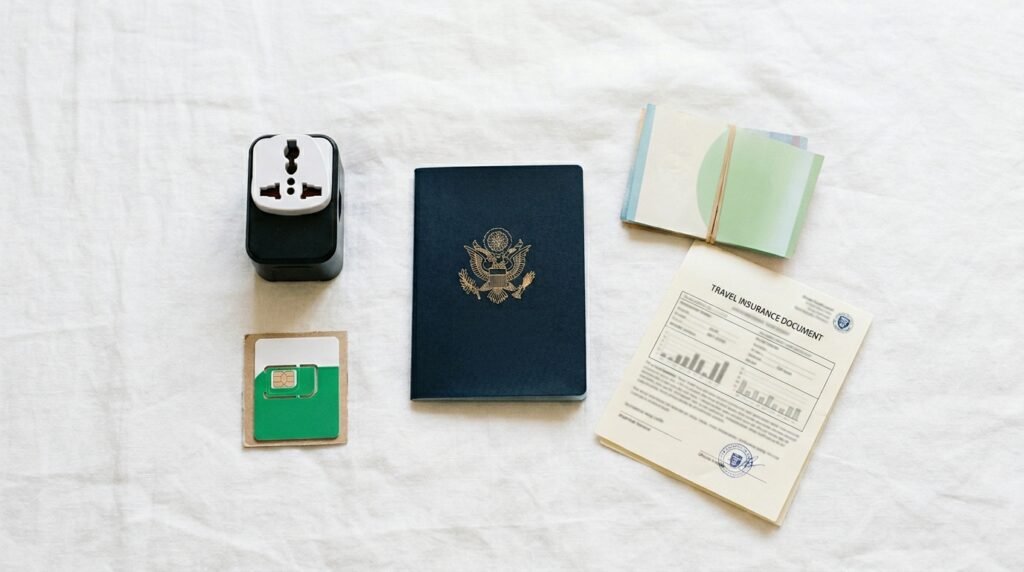
Portugal uses Type F plugs (two round pins, European standard) and 220 volts — not the 110-volt system Americans are used to. Your US plugs will not fit without an adapter.
Most modern American electronics (laptops, phones, cameras) are dual-voltage and will handle 220V automatically — check your charger for “100-240V” to confirm. Older single-voltage devices (some hair dryers, curling irons) need a voltage converter, not just an adapter.
Buy a universal travel adapter before you leave — they cost $10–$15 on Amazon and are easier to find at home than at Lisbon airport.
Your Phone in Portugal
Portugal uses 4G and 5G networks across cities and most tourist areas. Your US carrier’s international roaming plan will work, but data charges can be significant. The better option for a trip longer than a few days: buy a local SIM card at Lisbon airport on arrival (NOS or Vodafone both have desks there) for approximately €15–€20 for a month of data.
Alternatively, download the Uber and Bolt apps before you go — both work across Portugal and are the most reliable, transparent way to get around cities.
Money in Portugal — What Americans Need to Know
Currency: The Euro
Portugal is an EU and Eurozone country — the currency is the euro (€). ATMs (Multibanco) are widely available and generally offer fair exchange rates. Credit and debit cards are accepted almost everywhere, including small restaurants and markets.
The practical rules:
Use ATMs attached to major Portuguese banks — Millennium BCP, Novo Banco, and Caixa Geral de Depósitos. Standalone ATMs in tourist zones sometimes carry higher fees and in rare cases have skimming devices.
Always pay in the local currency and avoid dynamic currency conversion. When an ATM or card machine asks if you want to pay in US dollars, always say no. The exchange rate offered is consistently worse than your bank’s rate.
Keep some cash for small purchases, market stalls, and the occasional small café or village restaurant that doesn’t take cards, but cards work reliably in 95% of situations across Lisbon, Porto, and the Algarve.
Tipping in Portugal
American tipping culture does not apply here — and that’s a welcome change for your wallet. In Portugal, service staff receive a living wage and tips are genuinely optional.
The local custom: round up your bill or leave a small amount — 5–10% at a sit-down restaurant is generous and appreciated. At coffee shops and casual spots, leaving the small change is perfectly normal. At bars, tipping at all is unusual. Nobody will think badly of you for not tipping — but a small gesture is always noticed warmly.
The Bread and Olives Trap
This is the one that catches every first-time American visitor, and it costs money if you don’t know about it.
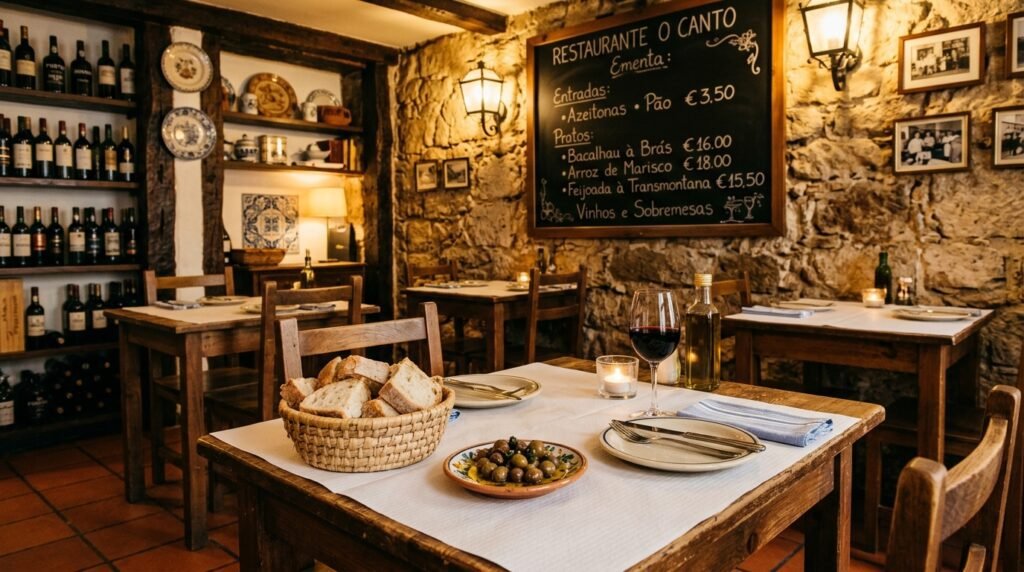
In many Portuguese restaurants, the waiter will bring bread, olives, butter, and sometimes small appetisers to the table without being asked. These are not free. They are a cover service (couvert) that appears on your bill — usually €1.50–€4 per person. If you eat them, you pay for them.
If you don’t want them, simply say “não, obrigado” (no, thank you) when they arrive or push them gently to one side. The waiter will remove them. You won’t be charged for anything you don’t touch. But the moment you eat an olive, the clock is ticking.
How Much Does Portugal Cost for Americans?
Portugal remains one of the most affordable countries in Western Europe, though it is no longer the extreme bargain it once was. While prices in popular hubs like Lisbon and the Algarve have increased, the country still offers expenses 30 to 50 percent lower for travellers compared to France, Italy, or the UK.
Here’s a realistic daily budget guide in USD for 2026:
| Budget Type | Daily Per Person | What You Get |
|---|---|---|
| Budget | $70–$100 | Hostel or budget hotel, local restaurants, public transport, free attractions |
| Mid-Range | $130–$180 | 3–4 star hotel, sit-down meals, occasional tour or activity |
| Comfortable | $200–$280 | Boutique hotel, good restaurants, day trips, tasting menus |
| Luxury | $400+ | 5-star, fine dining, private tours, Algarve resorts |
Portugal has 46 Michelin-starred restaurants as of 2026, offering exceptional fine dining at the upper end.
Flights from the US: Direct flights from Lisbon to New York, Boston, and Miami take 6–7 hours, making Portugal one of the closest European destinations from the East Coast. Round-trip economy tickets typically range from $500–$1,200 depending on season and how far in advance you book. Spring and autumn flights are significantly cheaper than July and August.
Getting Around Portugal
Flying In
Most Americans fly into Lisbon Humberto Delgado Airport (LIS) — the main international hub with direct connections from New York (JFK and Newark), Boston, and Miami on TAP Air Portugal, Delta, and United. Porto Airport (OPO) also receives some transatlantic flights and is worth checking if Porto or the north is your main destination.
From Lisbon airport, the Metro Red Line connects directly to the city centre in about 25 minutes for under €2. Uber is also available at the airport and costs approximately €10–€15 to central Lisbon. Avoid the unsolicited taxi drivers inside the arrivals hall — take Uber or the official taxi rank outside.
Driving in Portugal
Renting a car opens up Portugal enormously — the Algarve’s hidden beaches, the Douro Valley vineyards, the Alentejo plains, and Sintra are all significantly more accessible by car than by public transport.
The rules are familiar: Portugal drives on the right, the same as the US. Your American driver’s licence is valid. Road quality is generally excellent on major routes.
Portuguese drivers are assertive. Tailgating on highways is standard, roundabout rules are treated as suggestions, and parking in Lisbon and Porto is genuinely challenging. Roundabouts appear constantly — traffic inside the roundabout always has priority. Adjust your expectations at the wheel and you will manage fine.
In cities, don’t drive. Lisbon and Porto have good public transport, and parking is an exercise in patience. Save the car rental for day trips and regional exploration.
Public Transport
Lisbon has a reliable Metro, buses, and the famous historic trams. Buy an Andante card in Porto or a Navegante card in Lisbon — both are reusable cards that cover all public transport within each city for a fraction of individual ticket costs.
Between cities, CP trains connect Lisbon and Porto in under 3 hours. The Alfa Pendular express service is comfortable and fast — book in advance online at cp.pt. For the Algarve, trains run from Lisbon to Faro in roughly 2.5–3 hours.
Cultural Differences Americans Always Notice
Meal Times Are Later Than You Expect
Portugal runs on a different schedule to America — and significantly later than most US visitors expect.
Lunch happens between 1pm and 3pm. Dinner rarely starts before 8pm; locals typically sit down between 8:30pm and 10pm. Arriving at a restaurant at 6:30pm will mean you’re eating in an empty room with the kitchen still warming up. Arriving at 8:30pm puts you in the city’s rhythm and in a room that feels alive.
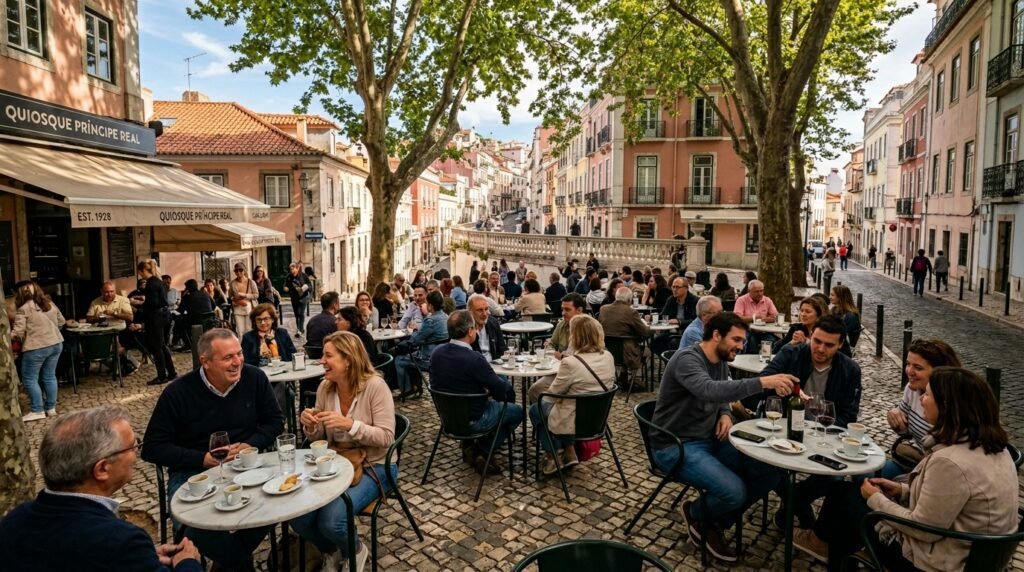
Breakfast is small and taken early — a bica (espresso) and a pastel de nata, standing at a café bar, costs about €1.50. Brunch culture is growing in Lisbon but is not yet universal outside the most tourist-facing neighbourhoods.
Coffee Culture
Portugal takes coffee seriously, and the vocabulary matters. A bica is a small, strong espresso — the default coffee order. A galão is the closest thing to an American latte — espresso with lots of foamed milk, served in a tall glass. Asking for “a coffee” will get you an espresso, not a large drip coffee. If you want something closer to American coffee, ask for café americano — though you’ll still get raised eyebrows and something considerably smaller than you’re used to.
Never order a cappuccino after a meal. In Portuguese culture, milk-based coffees are morning drinks only.
Don’t Assume Spanish Works
Portuguese people generally understand Spanish, but they prefer you don’t assume the languages are the same — it’s a point of national pride. English is a better default in tourist areas. Learning a few Portuguese phrases will be appreciated far more than defaulting to Spanish.
A few words go a long way. Obrigado (men) or obrigada (women) means thank you. Por favor is please. Com licença means excuse me. Faz favor is the standard way to get a waiter’s attention. Using any of these correctly will earn you immediate goodwill.
When Should Americans Visit Portugal?
Best months: May, June, September, October
These shoulder season months hit the sweet spot for American visitors — warm enough to swim and explore comfortably, without the intense heat and crowds of July and August. Flights and hotels are noticeably cheaper than peak summer. The Algarve is beautiful and manageable. Lisbon and Porto feel like cities rather than tourist corridors.
July and August are the most expensive and crowded months. If your schedule only allows summer travel, go — Portugal is still excellent — but book accommodation and activities well in advance and expect busier beaches and higher prices.
November through March is genuinely quiet. Prices drop significantly, the light in Lisbon is beautiful, and the cities feel authentically local. The Algarve is mild in winter and largely empty. This is when the best restaurant tables are suddenly available without a three-week wait.
Quick-Reference Tips for Americans
At restaurants:
- Bread and olives on the table = not free. Eat them and pay, or push them back
- Tip 5–10% at sit-down restaurants — it is appreciated, not expected
- Always ask for the menu (ementa) rather than the tourist fixed menu displayed outside
- Dinner before 8pm = tourist hours. 8:30pm = local hours
Getting around:
- Uber and Bolt work across all major cities — always use these over street taxis
- At Lisbon airport, the Metro is faster and cheaper than a taxi to the centre
- Rent a car for the Algarve and countryside; don’t drive in Lisbon city centre
Money:
- Always pay in euros, never accept dynamic currency conversion in dollars
- Use bank-branded ATMs, not standalone kiosks
- Cards work nearly everywhere; keep €50 cash for small purchases
Communication:
- English works well in tourist areas; a few Portuguese words earn real appreciation
- Do not attempt Spanish as a substitute — use English instead
- Google Translate works well for menus and signs
Electricity and phones:
- Buy a universal Type F plug adapter before you leave home
- Check your devices for dual-voltage (100-240V) before packing
- A local SIM from NOS or Vodafone at Lisbon airport gives you cheap data for the whole trip
Frequently Asked Questions — Portugal for Americans
Do Americans need a visa for Portugal in 2026? No visa is required for stays under 90 days. Americans enter visa-free as part of the Schengen Agreement. However, ETIAS — a new online pre-travel authorisation — is expected to launch in late 2026 and will be required before every Schengen trip. It costs approximately €7 and is valid for three years.
Is Portugal safe for American tourists? Yes — Portugal holds a US State Department Level 1 travel advisory (“Exercise Normal Precautions”) and ranked 7th on the 2025 Global Peace Index. The main risk is petty theft in crowded tourist areas. Violent crime affecting tourists is extremely uncommon.
Is English spoken in Portugal? Widely and well, particularly in Lisbon, Porto, the Algarve, and all major tourist areas. Younger Portuguese people in particular often speak excellent English. Rural areas have less English coverage, but even there some communication is usually possible.
How much cash should I bring to Portugal? Cards are accepted almost everywhere in cities and tourist areas, so you don’t need to carry large amounts of cash. Bring or withdraw €50–€100 for small purchases, market stalls, village restaurants, and tipping — and use ATMs attached to major Portuguese banks for the best exchange rates.
What is the best city to fly into for a first-time visit? Lisbon is the most common entry point and makes the most sense for a first trip — it’s the capital, the most connected internationally, and within easy reach of Sintra and the Alentejo. If your main interest is the north and the Douro Valley, Porto has direct transatlantic flights worth checking.
Is Portugal good value for American tourists? Excellent value compared to most Western European countries. A comfortable mid-range trip costs roughly 30–50% less than equivalent travel in France, Italy, or the UK. Food, wine, accommodation, and tours are all significantly cheaper than US equivalents at the same quality level.
Plan Your Portugal Trip
Tell our AI travel planner your dates, budget, and what kind of trip you’re after — and we’ll build a personalised Portugal itinerary in minutes, with real recommendations, hotel options, and tour bookings.
👉 [Start planning my Portugal trip →]
Explore more:
- [Is Portugal Safe to Visit in 2026? →]
- [Sintra Day Trip from Lisbon →]
- [Things To Do in Porto in 3 Days →]
- [Algarve Beaches Without Crowds →]
Last updated: June 2026. ETIAS launch timeline sourced from official EU announcements. Entry requirements and travel advisories confirmed from US State Department and Schengen official sources. Always verify current requirements before travel.